January 30, 2007
The wind is in from the Canadian tundra and the air has gotten drier and much colder — almost like winter. And that dreadful Senator Boxer from California has engineered a shortage of pseudoephedrine. Californians! What do they know of sinuses?
I woke up the other morning and decided that the curves I’ve been thinking about are called sinusoidal. That just means they have pockets and peaks. Undular, if you will.
So, I googled, “sinusoidal origami,” and dang! There’s Leong Cheng Chit there, ahead of me. Foiled again! Curses!


Posted in non-content, sinusoidal, twist by: oschene
No Comments
January 21, 2007
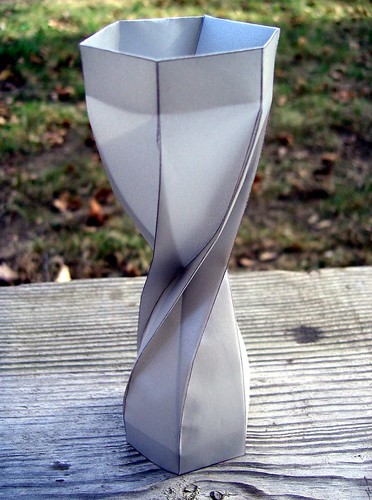
Melisandean Flute
Mélisande* gets half credit on this one, for suggesting that the paper on the edges could be folded down to hold the piece together. This model has a much nicer waist to it, more suggestive of an actual glass. I suppose the next step is to work on a stem and base.
Posted in content, crease pattern, creative commons, curved surface, sinusoidal, twist by: oschene
2 Comments
January 18, 2007
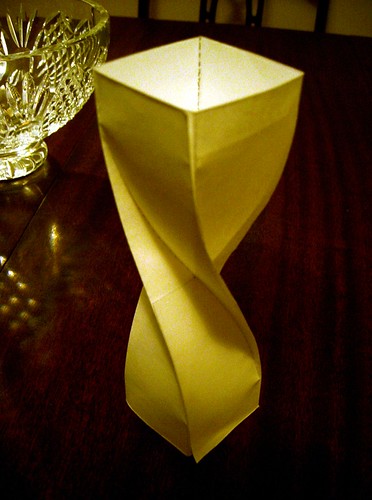
Champagne Flute
The bold lines are cut marks.
Yes, yes — blasphemy. Okay, you don’t have to cut on the bold lines. If you wrap the fifth part, it’ll hold together just as well. Me, I just think it’s a more satisfying model if you give it a little cut, either side.
C’mon – how pure do you want to be?
Posted in content, crease pattern, curved surface, rectangle, twist by: oschene
8 Comments
January 14, 2007
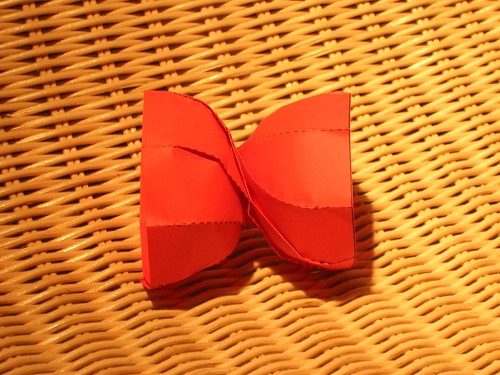
Photo and folding by Mélisande*
¡El Diabolo!
Ah, Mephistopheles!
–Christopher Marlowe, The Tragical History of Dr. Faustus
Posted in content, rectangle, twist by: oschene
3 Comments
January 13, 2007
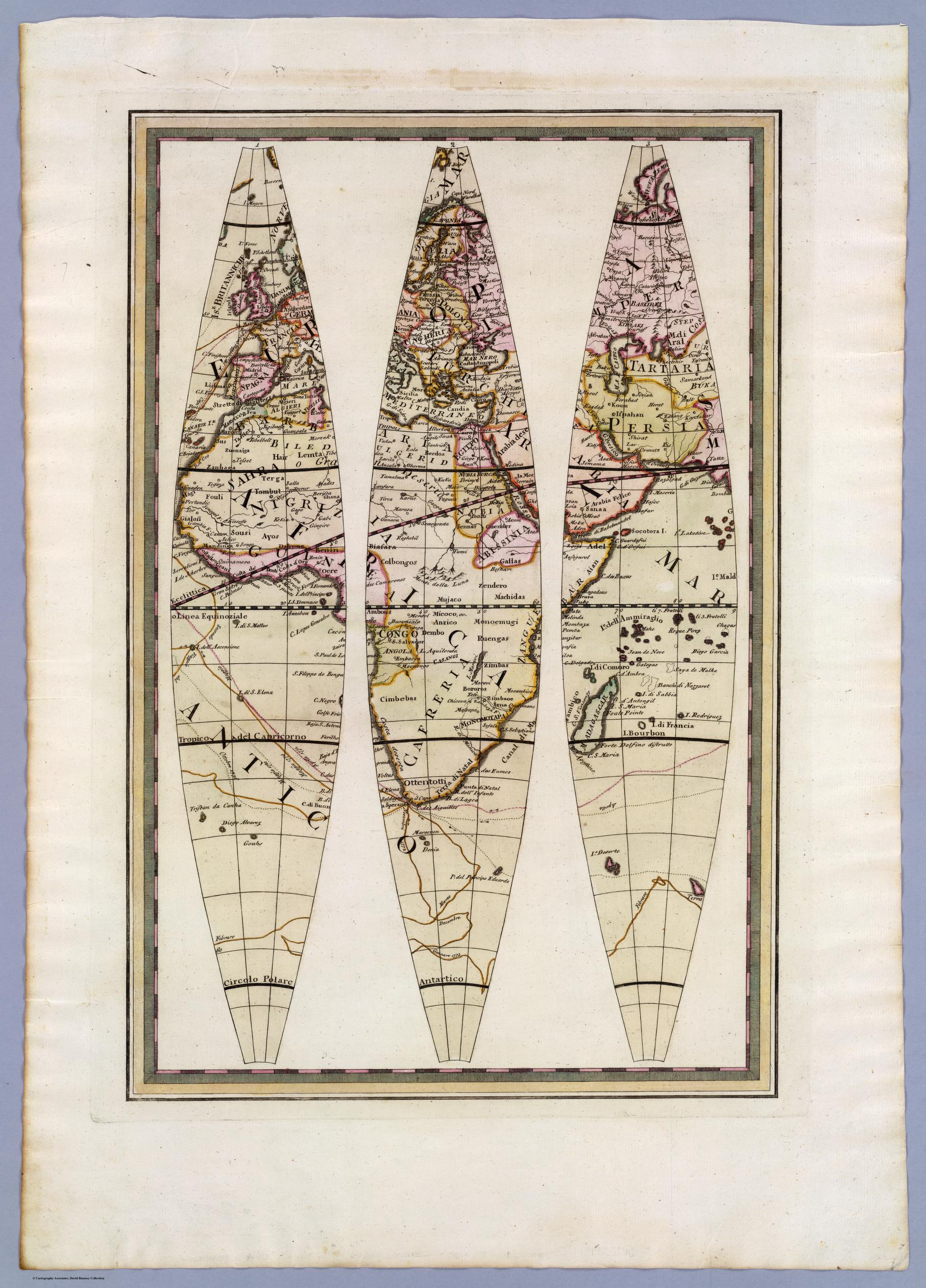
This is a section of Giovanni Maria Cassini’s globe, a very beautiful object, which you can view in great detail at David Rumsey’s map site. You can see that Cassini knew something I was just guessing at, how to find the radius of the curve of map gores. Dr. Math tried to explain it to me, but he’s a mathematician and I’m a dilletante and we have trouble communicating. Every time I read the term “radians,” a wee pixie comes in through the cat door and blows out my pilot light. The eyes glaze over and the frontal lobes grow cold and I wake up eight hours later, surrounded by empty 40 ounce malt liquor bottles and professional wrestling, blaring on the television.
This is not the royal road to geometry. This is not even the on-ramp.
I kept thinking it was a spherical triangle thing. It probably is, but since I can’t manage to get the concept into my head, I tried doing it with good old Pythagoras and a piece of paper. (Well, actually, I was sketching madly on my tablet pc, amusing the other bus passengers no end.) It is not beautiful, but I think it works. Feel free to disagree; I won’t argue.
Gore Math
(For our foreign readers, I will mention that a pixie is a small, semi-mythical being, very like a leprechaun, but with a post-punk sensibility.)
Hey, speaking of Pythagoras, are any of our South Asian readers familiar with the medieval mathematician, Bhaskara II? Came across a reference to his having done a proof of the Pythagorean theorem by folding paper, but I can’t find any details on this.
Posted in non-content by: oschene
1 Comment
January 11, 2007
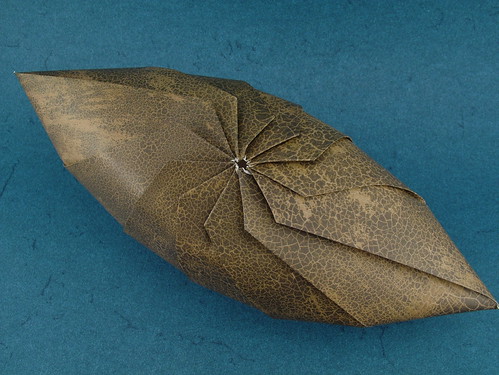
I know that Eric has already blogged this, but this will not stop me from noting that lilzabubba (who is also known as Bekah) has made a rather more rational crease pattern for the lunoid model. And made a nice double lock on those troublesome corners — very clever, never occurred to me. lilzabubba’s Crease Pattern
Hmm, lots of diagramming going on in the Land o’ Lakes — do we see a book in Bekah’s future?
Posted in content, crease pattern, curved surface, square by: oschene
4 Comments
January 1, 2007

This was one of my first models, I think – I was about 13. It’s corrugated for extra goodness.
I had thought it one of my simpler models, but making a CP has taught me otherwise. It’s still fun.
Here’s the crease pattern.
And a Happy New Year’s to all!
Posted in content, crease pattern, creative commons, open source origami, square by: oschene
4 Comments
December 22, 2006
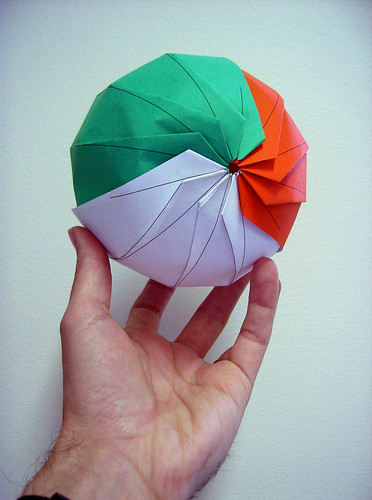
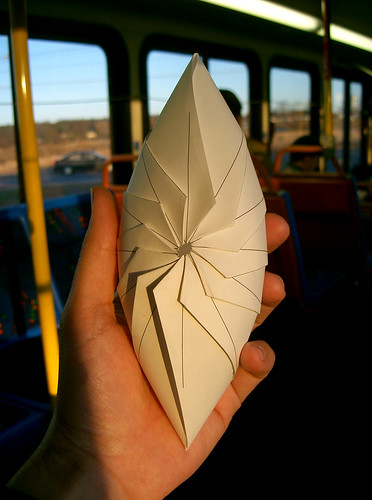
Gore Square (deprecated – feh, uck, ptui)
Better Gore Square
For experimental use – it’s not quite done yet.
(Oh, and if any of those fancy New York design firms are curious, we may be open origami evangelists, but we can be bought licensed.)
Posted in content, crease pattern, creative commons, curved surface, square by: oschene
12 Comments
December 17, 2006
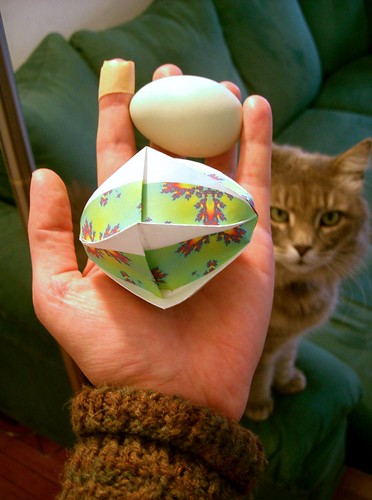
Don’t mind the cat – Basil’s just been into the catnip and he’s a little stoned.
I decided it would be fun to color the gores of the curved surface waterbomb, to enhance the general eggyness of it.
“Easter egg” is a term programmers use to describe little secret treats they leave in their code, like a little video game hidden in a spreadsheet program. I reckon that by hiding a an origami crease pattern for an Easter egg in my blog during the Advent season, it’s sort of similar. When folders go googling for egg diagrams in late Lent, they’ll find this one, maybe.
So, some file to play with:
The crease pattern
The two-sided crease pattern with colorful fractal images on the back
The two-sided crease pattern with just lines on the back (you draw the pattern, yes?)
With the two-sided ones, you can print them back to back, depending on your printer and your level of comfort with your printer driver. The crease pattern part is oriented to fold up inside the egg. The flaps on top fold over and tuck into the curvature of the buttress thingee there — I left that in white, again, to call attention to the essential eggyness.
Yes, you can hide jellybeans inside. But not Jelly Belly® brand, for that kind is inextricably associated with the memory of that father of lies, Ronald Reagan.
Posted in circle, content, crease pattern, creative commons, curved surface, egg, pysanka by: oschene
1 Comment
December 16, 2006
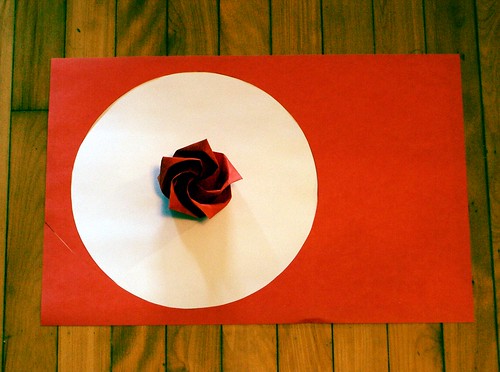
A Chad Stewart from some place Southern writes in to say, “Hey, y’all! where’s the phreakin’ diagrams?”
Em. Haven’t made them yet. We will, but we’re still waiting for understanding to take place. (Ours, that is; yours will come later.)
Of course, if the world stopped every time we didn’t understand something, we’d still be negotiating with Khrushchev. Here’s a slightly improved Crease Pattern for your experimentation pleasure.
After I drew this, I realized this model has up and down to deal with. Okay, this is the underside of the rose you’re looking at, and the spiral will come towards you as you twist it, to form the top of the stem. The other side of the paper will be surface of the petals — no lines showing.
I’m not positive this CP is 100% accurate, but we’ll see. It’s the side locking that’s the real tricky part.
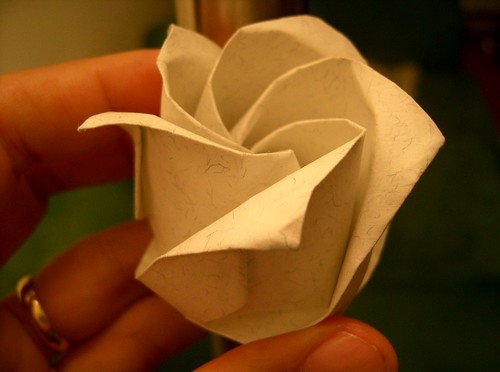
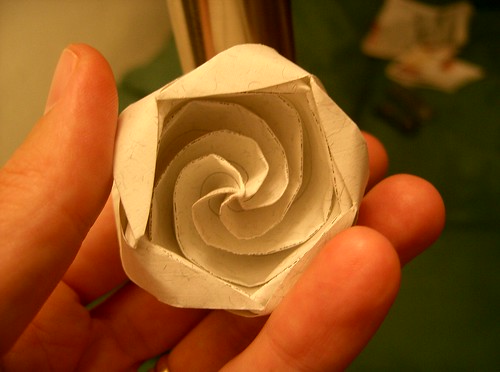
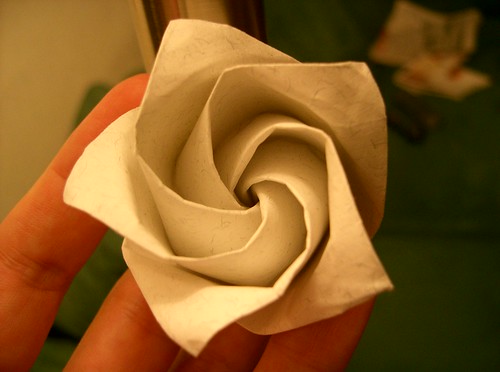
Here are some other shots:
Posted in circle, content, open source origami, origami rose, pentagon, twist by: oschene
11 Comments


