The Fitful Flog

December 10, 2005

Geflocktne Dreidl


Dreidl is a Yiddish word meaning “top” or “little spinning thing.” Geflocktne means “twisted” or “interwoven.” I’m not in the least sure about the inflection – please feel free to send corrections. This one is showing nun up, meaning that you win nichts, nada, niente, nichievo, not so much. Spin again, please.

At Hanukkah, it traditional to spin the dreidl and play for chocolate coins or nuts. Some time in the 80s, after Kasahara’s Omnibus came out and I learned how to divide things into fifths, I made a dreidl from a square. It was a tube with one fifth overlapped. It was okay, but it didn’t spin very well and I always had this nagging feeling that the top was rigged, just like loaded dice. And someone else independently created and published diagrams before I did. Really, it would be hard not to do it that way.

This one is made from a silver rectangle (A5, specifically) and uses a couple tricks to avoid the pitfalls of my last attempt. By twisting the paper, we get one fourth of the weight on each side, while still allowing us to box in the space and lock it shut. Knowing that there wasn’t sufficient weight to get it to spin for any length of time, we drop a Tootsie Pop into the interior and use the stick as the handle. The lollipop weighs six tenths of an ounce (or masses 17 grams, for those of you keeping score at home), just about enough to maintain centripetal force for a few seconds. And it’s kosher.

This fold is dedicated to Mrs. Petzel, who lived in my town when I was a gormless lad and frequently lent me origami books and BOS magazines. She lives in San Diego now and is more widely known as Florence Temko.

The CPs are here:
Geflocktne Dreidl for A4 paper
Geflocktne Dreidl for American letter paper

A slideshow showing the construction is at Flickr.

November 24, 2005

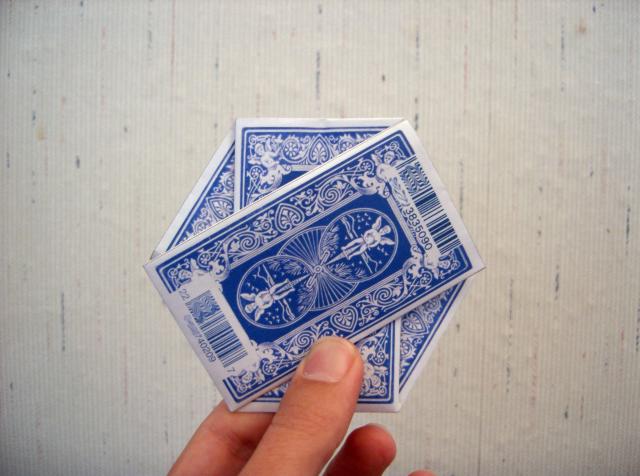
The Three Card Monte


Greetings, Metafiltrationists — what’s up with that $5.00 cover charge? This post is from a while back and better instructions can be found on this post.

Greetings, Boing-Boingers. The files are linked farther down the page. There is a how-to and you can find it here. Make sure you turn the page scaling off when you’re printing the crease pattern or the card model.

And hey, feel free to visit the rest of the site, The Fitful Flog. It’s a blog, y’know?

Today is Thanksgiving in America and we celebrate by posting an American letter paper fold – that’s 216mm x 279.4mm to those of you suffering under the conceptual hegemony of the Vichy metric system. One ten millionth of the way to the North Pole, indeed. Such nonsense.

Anyhow, I was standing behind one of our students in the dining hall as she was trying to extract her school ID from a very tiny plastic envelope. She had maybe ten cards in that thing, and she was tugging one out after another to see if it was the right one. I thought, geez, an accordian wallet might be the thing for that.

But kind of bulky, no? So, I thought about how thick my wallet gets with all the cards I have to carry in this fallen age. Torques the spine, just sitting on it. Cards for this store and that account and membership in the other, oh, it’s like George Costanza’s wallet, one scrap away from utter explosion.

Then I thought, well, I really don’t need most of these cards. Mostly, I just need the data on them. So, I entered my ATT phone card numbers into my BlackBerry and that was one card gone. I kept going in this manner and emptied out most of the pockets in my wallet. At the end, I decided I needed just three cards on most days: my license, my school ID and my debit card. I took them out and played with them a while. I noticed that if you lined up the corners, they almost make a hexagon.

With some more investigation, I found that all my cards were two and one-eighth inches wide, or exactly one quarter of the width of American letter paper. Well, that was challenge enough for me. I folded up a three card wallet that twists flat into a hexagon – ever notice that the bottom of the shirt pocket on most men’s shirts describes an angle of just about 120°? Oh, yeah, you can dig it. And when you open it, you can see each card.

The first one I made, I used Tyvek from a large mailing envelope. This worked very well: quite rugged and had an unryu thing going on. But then I thought, if I could somehow get barcodes on the back of the thing, I could eliminate two other cards, the cards I use to get deals at the supermarket and drugstore. You trade your buying habits for discounts, these days. Real quid pro quo stuff. You can see my thinly veiled attempts at steganography here. It works, but I think it annoys the counter help. Sometimes, they look as if they think I’m hacking their system.

So, here are a couple PDFs. One is the CP, the other, the fancier card model – minus my barcodes, of course, but weighing in at a hefty 1.57 MB. I’d right click and Save As, if I were you. Some may say that my use of playing cards images here is pushing the boundaries of fair use. I think I’m within the limits, but if you own the design and feel differently, please let me know.

Three card monte, by the bye, is a street hustle. If you’re unfamiliar with the game, you can get the allusion here.

Creative Commons license on these, natürlich. There is no A4 version of this fold, but you folks out there in the A4 lands are encouraged to come up with one.

November 20, 2005

Pentagonal Compass Rose Box and φ-Quiddity

Pentagonal Compass Rose Box

Howdy — coming here from the Origami Resource Center? Welcome, but please be advised that this particular model is crazy difficult and just about anything else on the site would be easier to fold. Here, try the model menu.

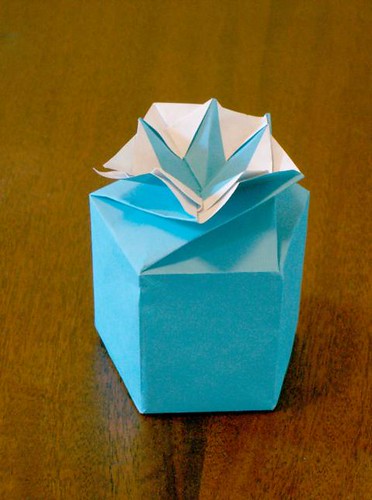
This is the Pentagonal Compass Rose Box, made from a golden rectangle.

CP for American letter paper

CP for A4

The CP is meant to be white side up; blue is mountain fold, red is valley fold.

This model comes out of a lot of thought about current origami chatter and the nature of things. I have been turning over an idea in my mind about an open-source origami rose – folders love those complex roses, sometimes with an inordinate love. I was thinking that we should have a new line of roses, somehow distinct from the Kawasaki line and entirely open to variation without propertarian hoo-ha.

It’s one thing to consider this a desirable object, quite another to invent it.

And then, I wanted to avoid the tyranny of 45° and 22½° angles and even the insurgent purity of 30° and 60° angles. No, I thought, the open-source rose requires ?-quiddity to make it go, for only five-fold symmetry will make it come alive.

Well, I’m not there yet. The open-source rose remains one of those ideas that rotate in front of me when I’m drowsing between the snooze alarms. But there’s always the creations on the by-way.

A pentagonal compass rose box is a theoretically impossible thing. But since the theory is largely of my own making, I decided to be reasonable about it. When you twist shut a tube with an odd number of sides, the corners and sides never line up. And you can’t collapse something that doesn’t line up. But, I thought, what if you twisted it twice and bashed in the corners?

Yup, that works, though it’s not the easiest collapse I’ve seen. You get to make two collapses at once and the paper puts up a fight. Persevere. It would probably make a nice wrapping for a Christmas present.

The golden rectangle has a ratio of 1:(?5+1)/2 and is full of lovely 3-and-5 resonances. For instance, if you divide it in sixths one way, it divides itself in fifths of its own accord. and 36°, 54° and 72° angles are to be had without too much struggle. Joseph Wu has a piece on folding silver and golden rectangles here. I got a lot of the math for this from Kasahara’s Origami for the Connoisseur and Amazing Origami.

Creative Commons License
The Pentagonal Compass Rose Box (both A4 and American Letter versions) are licensed under a Creative Commons Attribution-NonCommercial-ShareAlike 2.5 License.

October 29, 2005

Puff Star

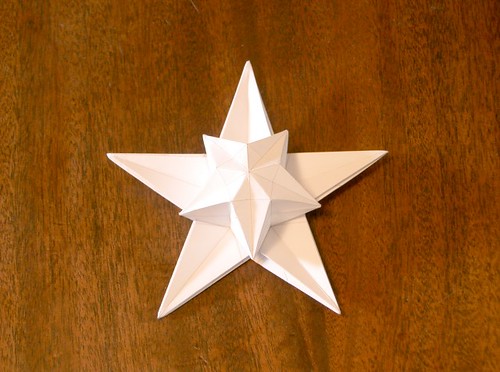
Puff Star
This fold took its inspiration from the little puffed stars we used to make by tying overhand knots in perf strips. (Remember perf strips?) Also, one night, I got to wondering, what happens if you make a bird base from a pentagon?

As it turned out, the model was much cooler when made from a decagon. Some purists eschew folds made from convex polygons other than squares. I am not one of them.

These look spiffing on a Christmas tree.

Want a CP? This one’s for 8½ × 11 and this one’s for A4. They were made to extend to the sides of the paper, so you’ll see a quarter inch or so missing. You can always shrink to fit in the print dialog.

Creative Commons License
The Puff Star (both A4 and American Letter versions) is licensed under a Creative Commons Attribution-NonCommercial-ShareAlike 2.5 License.

August 28, 2005

The 16-Sided Compass Rose Jar, Continued

16-Sided Compass Rose Jar
The 16-Sided Compass Rose Jar, shooting down the interior, to show the compass rose.

A crease pattern to follow shortly.

August 28, 2005

The 16-Sided Compass Rose Jar

16-Sided Compass Rose Jar

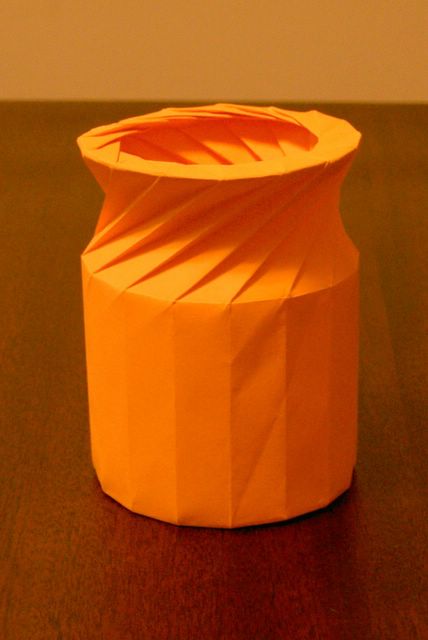
The 16-Sided Compass Rose Jar, showing the one-sheet hyperboloid shoulder and iris rim closure. This one is made of a 12×18 inch piece of 50# art paper. Note that the interior is the same color as the exterior. This model has no white showing.

Compass rose jars, no matter how many sides, have the some interesting properties. The left and right edges are tightly butted to each other along the entirety of their length. The top and bottom edges meet along the whole of their width, as well, though they are offset by half. You could, in theory, glue these edges together before collapsing the model. In topological terms, this is genus one, a toroid – more a doughnut, if you will, than a jar. Another way of thinking of it is that the paper becomes a tube both north-south and east-west – it’s Totally Tubular.

The compass rose at the bottom is a helical twist and a reversal, something we call the Dirty Diaper Bag Maneuver.

This one has a one-sheet hyperboloid at the top and an iris closure. That’s kind of a pun, you know – a one-sheet hyperboloid made with just one sheet of paper.

Whoa, calm down there.

August 14, 2005

Spiral Data Tato


CP (American Letter)
CP (A4)
Slideshow

Update: now there’s an instructables.com tutorial with video and everything!

It all started in a Marketing and Recruiting meeting at this telecom call center I was working for. It was at the height of the dot-com idiocy and I must admit, I was being just as idiotic as the next chap. (Hell, I’m proud of it – it’s not like I got fat and rich off my idiocy.) The theme of the telecom’s advertising at the time was Soviet Constructivism and you can guess how many units that moved. The campaigns looked like something out of Weimar Germany, all red and black and sepia-tint – not the nice parts of Weimar Germany, you dig. We were spending several dollars a piece for Welcome Kits – just a fancy holder for a CD containing our ISP’s dialers and other people’s software. The manager of our call center said that these Welcome Kits weren’t terribly welcoming and most of us agreed warmly – nobody wants to do business with neo-Nazis. The nice young woman from Corporate began to speak very slowly and distinctly, as if she were talking to some particularly backwards third graders. She explained the psychological underpinnings of the ad campaign and hinted around some about our undeniable provincialism and lack of marketing education. I tried to get across to her that it wasn’t that we didn’t understand these lofty concepts, it was just that we thought Corporate was dead wrong.

Later on, they switched to an S&M theme that was even more offensive, yet even less successful at capturing customers. And boy, it was expensive. Those Corporate kids really could pound dollars down a rat hole when they put their minds to it. The whole thing is moot now – the call center is gone and the telecom is long since out of money. I’m now at a heavily endowed liberal arts college and those Corporate kids are off robbing somebody else’s pension fund.

I began to think of ways to make an inviting CD holder cheaply at that meeting. I came up with several ideas, but I liked this one best. It’s made with American letter paper, the old 8½ × 11 medium I’m so fond of. It’s a sort of tsutsumi, you know, that fancy Japanese gift wrapping that’s so pretty and complicated that you’re afraid to open it. But this one has a zipper so you can do it up again. (An Origami Zipper®? Sure, wherefore not?) Plus, it’s mailable without using any sticky sealers.

It’s not elegant – the math here is a sort of brute force arithmetic to get to the right diameter. And it takes a long time to make. If you want something simple and elegant, I will recommend Tom Hull’s American CD Case.

The crease pattern can be had here. I still haven’t gotten around to diagramming it, but here’s a slideshow that explains how to do it from scratch. (In the interests of fair play, I’ll mention that I got this script from Zinkwasi. It’s called PHPSlideShow v0.9 and was written by Greg Lawler.)

And I also realize that most of the world still languishes under the conceptual hegemony of the Vichy metric system and does not know from inches and pounds. Until they leave their heathenish ways and convert to a less arbitrary, more humanist system of measurement such as US Customary or Roman Imperial, we must make allowances. Here’s a crease pattern for A4 paper. It uses elevenths instead of ninths.

Creative Commons License

The Spiral Data Tato (American Letter Paper Version) is licensed under a Creative Commons Attribution-NonCommercial-ShareAlike 2.5 License.

Creative Commons License

The Spiral Data Tato (A4 Version) is licensed under a Creative Commons Attribution-NonCommercial-ShareAlike 2.5 License.

August 8, 2005

The Dollar Bill Stamp Dispenser

Dollar Bill Stamp Dispenser

This is what I was trying to do when I made the Dollars to Doughnuts! fold. Happy accidents. This is the same in construction – see the hints sheet below – and is actually rather easier to collapse, as the overlap in the middle is graspable.

Threading the stamps is a bit tricky: you have to coil up the stamps a bit more tightly and pop them in. But once done, it’s a very cool fold, indeed. Here’s the pdf of the crease pattern.

Note the Creative Commons icon. You may copy and distribute and teach this fold as freely as you wish, so long as you don’t attempt to make money off of it. You want to make money, you can email me and we’ll talk.

Creative Commons License

This work is licensed under a Creative Commons Attribution-NonCommercial-ShareAlike 2.5 License.

August 7, 2005

Café Kinko?

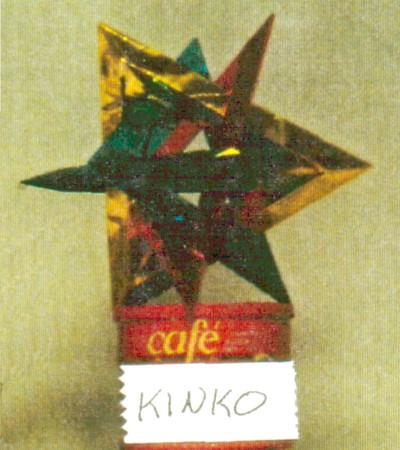
Café Kinko Four Hollow Triangles

Okay, it was ten years ago and the countergirl at Kinko’s® wouldn’t make a copy of this photograph until I covered up the trademarked image on the Café Goya® can. I pointed out that it wasn’t meant to be a picture of a coffee can – the can was just there for scale. But she was very strict. Some years later, we both ended up at the same company and I found out that her last name is Pilon. Is it possible her strictness was because I drank Café Goya® instead of Café Pilón® Or was it because she made a lifestyle of strictness? There is no knowing. But that’s not important right now – I’m attempting a metaphor here about intellectual property.

The thing on top of the coffee can is a Beefy Strut Four Hollow Triangles model. The photo was taken in December of 1995 and published in an APA I belonged to at the time. APA stands for Amateur Press Association – it’s a privately circulated magazine. Ours was organized on the Origami-L listserv and was pretty cool – still is, I hear. After a few years, my job got really twisty and I couldn’t keep up with the publishing schedule. But this is before – in 1993 or 1994, I published a model called Four Hollow Triangles (292 KB). Later on, in 1995, dissatisfied with the floppiness of the model, I made and published a more robust version called Beefy Strut (792 KB).

The other day, I was reading the website of this Famous Folder. (No, I’m not being facetious, he really is famous and I really don’t want to say his name – it’s not germane, this isn’t about him.) The Famous Folder has an article on his site, about five years old, in which he diagrams a model that’s almost the same in appearance as the Beefy Strut model. From a couple feet back, I wouldn’t be able to tell the difference. It’s clearly not theft – he’s done the math that I was unable to do and came up with a more elegant version. And I don’t for a minute think he ever saw my model before doing his. No post hoc, ergo propter hoc here: independent, penecontemporaneous creation happens.

When I looked at his article more closely, I noticed it had been published in the same APA in which mine had appeared. Origami’s a small world.

So, am I being pissy here, insisting on my slight claim to precedence, like I’m Lydia Wyckham or something? No. I’m making a point about intellectual property. The Famous Folder believes in strong copyright protection. I don’t. I’m not famous and I don’t make a living on my folding. I have the luxury of not having to worry too much about copyright.

Today, I kicked it around a while and decided I did want to put my lousy diagrams from 1994 and 95 out there. They’re historical. They were made on a 286 12 MHz box with a shareware CAD. On DOS. 5.25″ floppies. Burned anthracite, couldn’t handle bituminous.

The other move I’m making is to a Creative Commons license for my work. It’s like copyleft, but it does allow for some control over your designs after you release them. My particular license allows for free distribution but forbids commercial use without permission. Not that that has come up a lot, but I realized that the worry of losing economic control was slowing me down on a couple of my designs.

It isn’t origami till you share it.

March 20, 2005

The Grad School Coffee Filter

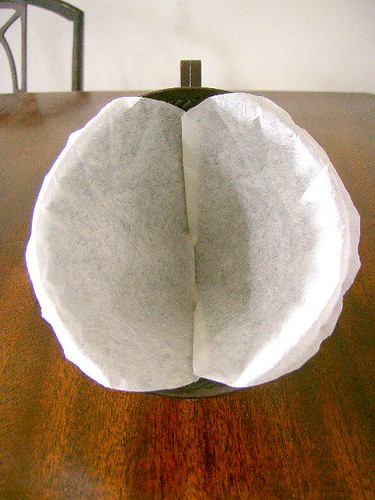
Grad School Coffee Filter

My days in grad school, now known to geologists as the Pleistocene, were remarkable both for their signal lack of productivity and for their relentless mortification of the flesh.

In those days, I learned all about rice and beans and dal and rice and ramen noodles and whatever. I learned about Black Label pounders in returnable bottles and rolling my own cigarettes. I learned about making my own Melitta coffee filters.

I had a Melitta eight-cup coffee pot in grad school that required special cone shaped filters, Number 6. When you can find them, which isn’t often. Sure, you can always find the Number 4 filters, but these are so short, you must needs stand there and titrate the water drop by drop so as not to overwhelm the cone. Once you locate the Number 6 filters, they’re three and four bucks for a box of forty. Absurdity. Without Ceres and Bacchus, Apollo grows cold.

After some thought and some experimentation, the Grad School Coffee Filter – a feat of utilitarian origami, surely. It converts two Mr. Coffee basket style filters (maybe a buck for three hundred) into a single Number 6 size cone. Diagrams can be had here.

The weight of the coffee and water will keep the folds straight and secure, even when chucking it into the trash afterwards. I do, however, recommend that you fold over the excess filter paper around the rim of the filter holder, as shown in the photo. Keeps it from drooping in when you’re pouring the water.

Of course, now that I’m back in the world and working for a living, I drink nought but very noisy espresso and have no use for such things. But I still see starving grad students on the bus. I can not give them wisdom – and would not, if I could – but I can give them this nifty fold.

Wait till you get to MLA, you silly children – you’ll have no more need for wakefulness. You will seek to brew your decaf with Lethe-water all of the days of your life.

CC 2026 The Fitful Flog | Entries (RSS) and Comments (RSS)

GPSwordpress logo

.