
Ten-Sided Yin-Yang Globe
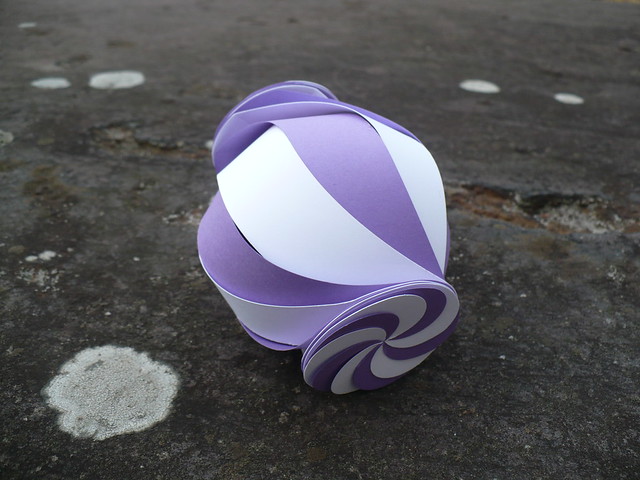
This is a ten-sided yin-yang globe, a modular kirigami model I designed for a friend to use in a gift exchange for the 10th Gathering for Gardner. Martin Gardner wrote the Mathematical Games section in Scientific American magazine for many years and had a big influence on a lot of folks, paperfolders not excepted. My brothers and I first learned of Samuel Randlett’s books from one of Gardner’s columns. My friend, Norton Starr, had four hundred of these models cut and scored at a local press and will be sending them out to his cohort shortly. This post contains the directions on how to assemble the model.
(For those of you who do not belong to the G4G group, there is no reason to feel disenfranchised — here is the template in PDF and you have only to print it out on two different colors of light cardstock or heavy paper. You then can cut the pieces out by hand — a little tedious, I admit — and assemble as described below.)

Step One — Carefully punch out the pieces from the templates.

Step Two — Make sure you have cleared all the paper from the inside of the hooks.

Step Three — Fold in on the indentations: not all the way, just partially as shown.

Step Four — Flip pieces over so that they resemble integral symbols.

Step Five — Place a white unit on the table and then a purple unit on top of it, rotated approximately 36 degrees counterclockwise. Note how the hooks overlap.

Step Six — Add a white unit, rotated approximately 36 degrees counterclockwise from the purple unit. Continue alternating units until all ten are in a star formation. (Don’t worry about being exact about the angles — the model will self-correct when assembled.)

Step Seven — This is all ten units assembled. Once you have this, flip the model over, so that the swirling circleStep Eight — Pull and curve up a white unit so that the top is about 3½ inches (10cm) above the intersection.

Step Eight — Pull and curve up a white unit so that the top is about 3½ inches (10cm) above the intersection.

Step Nine — Pull and curve up the purple unit to the left over the white unit. Hook the ends.

Step Ten — Pull and curve up the white unit to the left and hook in the same manner. Continue around the model until you have hooked all ten units.

Step Eleven — Hooking the last unit. When you release the disk, the model will compress at the equator and even out the angles.


HI
I have been given this link by a couple of my customers I wonder if I can make your little fancy box into a cutting file and offer freely on my blogg?http://forevermemoriesforyou.blogspot.co.uk/
My email is Tina.fitch@yahoo.com I would appreciate your reply
Thank you
June 5th, 2013 at 4:24 pmIt’s really good to make in art class.
I’m Korean elementary school teacher.
I want to make this one with my students.
So..How I make it’s planar figure?
October 19th, 2014 at 10:50 pmBom Dia , gostei do globo de Yin-Yang de dez lados gostaria de saber a possibilidade de me enviar o modelo . Pois quando fui abaixar o molde não consigui.
Achei lindo . estou pensando em fazer para decoração aqui na empresa.
Faço artesanatos para presentear as pessoas.
Sou Do Brasil.
Fico no aguardo de seu e-mail
March 23rd, 2017 at 8:39 amTenha um Bom Dia.